 Magic: The Gathering Commander players have an alternative deckbuilding assistant available to them. CommanderBracket, a free deckbuilding toolkit with unique features and content available on a web browser and phone application. Why CommanderBracket? CommanderBracket provides a user-friendly dashboard to analyze your Commander deck lists. Moreover, integrated features enable you to seamlessly link, paste, or import deck lists. CommanderBracket also reads Spanish, Portuguese, and Japanese card names. The Bracket feature enables you to paste in a deck list or a link to one located at Archidekt, Moxfield, ManaBox, etc. Or you may use My Decks to import decks from an Archidekt account or your devices. CommanderBracket is also helpful when you lack a deck list. The Build option lets you build a Commander deck by selecting a commander and answering a few questions. You can search for user-created deck lists and Precon deck lists, too. Recommended deck lists generate based on Commander Bracket level with combo suggestions. If desired, CommanderBracket will focus on your uploaded card collection for deck inclusion. CommanderBracket Key Metrics  CommanderBracket's deck list dashboard contains a slew of useful information backed by data. Let's review several desk list metrics using the MTG-Final Fantasy Limit Break Precon.
Card rarities in Magic: The Gathering comprise Common, Uncommon, Rare, and Mythic Rare. Typically, Play Boosters contain several Commons, and Uncommons, with one-to-three Rares and/or Mythic Rares. Over time, players accumulate piles of Commons and Uncommon from opening Booster packs and playing Limited events like Prerelease. These piles of extra Commons and Uncommons are often referred to as bulk. When a player no longer wants their bulk, they have a few choices. First, then can gift or donate the cards. Second, they can try to sell them to another person. Third, they can sell them to local game store (LGS). On average, a mix of 1,000 Commons and Uncommon (bulk) sells for $3.00 to $5.00 as cash or in-store credit. An LGS will either leave bulk unsorted and sell for a mark-up or sort bulk into singles.  Pulls from a bulk box Why Look Through Bulk? Sifting through bulk cards is a time-consuming process. However, there is an incentive for players to look through bulk boxes. There are many Common and Uncommon MTG cards worth multiple dollars. For instance, Untimely Malfunction, an Uncommon from Duskmourn: House of Horror sells for almost $10 per copy. Withering Torment from the same is worth about $3 per copy. Selling these two cards mixed in with other bulk from Duskmourn: House of Horror at bulk pricing would be unfavorable. So how do you know what bulk cards are actually buried treasure? My favorite website to view valuable bulk cards by set is MTG Dawnglare. You can search by format or set to see which Common and Uncommon cards are worth over $1.00. Just finding a handful of $1-2 cards from a bulk box can exceed trading in 1,000 bulk for $5. Also, you don't have to go through ever card in a bulk box if they are sorted by set or alphabetically beforehand. I'll share my favorite tips for looking through bulk further below. Beyond finding valuable cards, some players pick through bulk boxes at an LGS because they want to build their card collection. It is generally cheaper buying bulk cards as a lot than individual singles. Time spent picking bulk can save money by acquiring playable cards for MTG formats like Pauper and Commander. How to Sell Individual Bulk Cards Selling a stack of valuable bulk cards is easier than it sounds. There are a few options at your disposal:
Option 3 is my recommended approach. You can go to an online store such as Card Kingdom or Star City Games and start a buylist. This is time consuming as you will need to enter each card name in a search tool and see what they will purchase it for. However, there is a process to upload a CSV file as a buylist option that can save time. The most straight forward approach is downloading the Mana Box app to your phone and creating a free account. Mana Box also provides tips for creating and editing CSV files. You'll likely need to use Google Sheets to edit exported CSV files to meet a store's buylist requirements. To maximize returns and cover buylist shipping costs to an online store, I suggest trying to reach $100 per buylist submission. Further, achieving $100 in store credit meets most free shipping thresholds when you spend the credit. It may take 200-300 bulk cards to reach $100 in cash or credit value, but the reward is worthwhile. Recently, I traded in bulk to Card Kingdom toward a copy of The Mind Stone.   Reserved List pulls from bulk Tips for Effective Bulk Picking 1. Knowledge of the Most Played Commons and Uncommons in Constructed Formats The most played Constructed format cards are usually worth more than others of similar rarities. A great place to start is with MTGGoldfish's format staple lists. As a starting point, I recommend focusing on Standard-legal Commons and Uncommons. 2. Knowledge of the Most Played EDH Cards by Color EDH is a popular format with a huge card pool. EDHREC has most-played card lists by color, artifact, and land. Familiarizing yourself with the most-played Commons and Uncommons by color will help you spot potentially valuable bulk. 3. Reference MTG Dawnglare When Picking Bulk It is beneficial to reference MTG Dawnglare when looking through bulk. I try to pull aside any Commons or Uncommons worth over $1 by set. Moreover, if I come across an MTG set with no Commons or Uncommons worth over $1.00, I may skip it entirely. Due note that cards in a set worth less than $1 can still buylist to a store for $0.08 or more per copy. 4. Focus on Uncommon Rarity Symbols Every MTG set beginning with Exodus uses colored rarity set symbols on cards. Commons have black set symbols, while Uncommons have silver ones. When sorting cards, try focusing on Uncommons. I generally skip through all Commons in an unsorted bulk box unless I recognize the artwork or card name. The reason for doing this is because very few Common cards hold value. An exception to this rule is older sets like Zendikar, Fifth Dawn, and Dissension. Common cards can be worth a few dollars from older sets due to scarcity. I will also take my time looking through Modern Masters sets where card rarities are downshifted. 5. Make Piles of Cards from Sets Without Rarity Symbols It is hard for most players to remember the rarities of cards from sets like Fourth Edition, Ice Age, and Visions. These sets do not contain rarity symbols on the cards. Some players overlook this trait and place Rare cards in their bulk boxes. I strongly encourage you to set cards aside from these sets to check their value. Once you get a good-sized stack, you can quickly reference MTG Dawnglare. I have found valuable cards from early sets, including Reserved List cards, in LGS bulk boxes. 6. Set Aside Cards You Want to Play If you enjoy playing MTG and want to build a personal collection, you should set aside bulk to slot into decks. I often pull playable bulk cards for Commander and Standard formats. I've run out of copies of Arcane Signet, Cultivate, and Path to Exile more times than I can remember. 7. Know Shipping Costs When Buylisting Bulk It helps to know the price to ship a package of bulk cards to a online store. I typically spend around $8 to ship 200-250 cards for any given buylist across the United States. Alternative, USPS offers Priority Mall small flat rate boxes. These boxes hold around 400 cards regardless of weight. Priority Mail small flat rate boxes can be more cost effective when 300-400 cards in a package. Looking through bulk can be a profitable and rewarding way to build your MTG card collection. I've turned thousands of cards into Commander staples like Trouble in Pairs, Vampiric Tutor, and Cyclonic Rift. While pulling, sorting, and packaging bulk is time-consuming, you are rewarded for your efforts. Treasure hunting is also a fun part of the journey. I hope these tips improve your efficiency and add a few new cards to your collection. 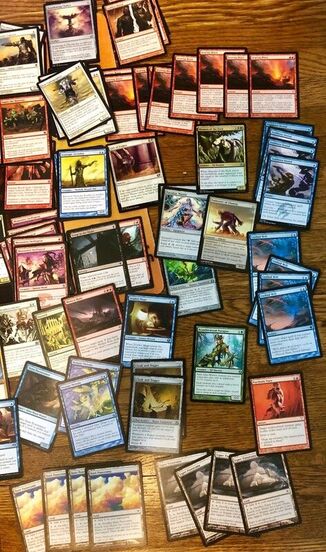 Additional pulls from my last bulk picking experience Magic: The Gathering's The Hobbit features nine unique extended art legendary creature cards only available in Collect Boosters. One of those cards is Dáin of the Ancient Halls, a red and white Dwarf Noble with an interesting attack trigger.  Dáin of the Ancient Halls appears ready to lead an army of Dwarves into battle. Moreover, Dáin's vigilance and haste abilities bode well for attacking opponents with a plethora of Dwarves. You can help Dáin trigger its ability and survive combat by equipping it with Stoneforge Masterwork, Bearded Axe, and other notable Equipment cards.
In my latest EDHREC article, Dáin of the Ancient Halls | A Dwarf Equipment Deck, I explore Dáin leading a Dwarf and Equipment-themed Commander deck. You can find out more about the deck's 99, including several infinite combos involving Aggravated Assault, by reading the article. The Hobbit's Fíli and Kíli, Joyous brings an unconventional strategy to the Magic: The Gathering Commander format by combining three very different themes: Sagas, Equipment, and Dwarves. The Dwarven brothers tap for two mana specifically to cast those three types of spells, giving the deck a unique mana accelerator. There are plenty of ways to turn that extra mana into serious value from Treasure-generating Dwarves like Magda, Brazen Outlaw to powerful Equipment like Kaldra Compleat.
The Sagas may be where things get especially exciting. Misty Mountains Cold, There and Back Again, and other Sagas can provide huge momentum swings in your favor. Once the deck gets rolling, massive flying Dragons and Equipment-enhanced creatures give you multiple ways to close out the game. If you’re looking for a fresh mono-red build that feels distinctly Middle-earth, check out the full deck tech at EDHREC and see how Fíli and Kíli bring the party to the battlefield.  |

Follow me
on Instagram @card_knock_life Categories
All
Archives
July 2026
This website contains affiliate links
A blog about the weekly grind of life and finding time for hobbies. |


 RSS Feed